Patient library / Costs, results & ongoing care
Biological Age Tests: What a Younger Score Can and Cannot Show
Understand biological-age scores before using them to judge a treatment. Ask about the test, repeatability, uncertainty and outcomes that matter to your health.
7 minute read · Costs, results & ongoing care
A biological-age score is an estimate produced by a particular method, not a direct measurement of years added to your life. A lower result after treatment does not by itself prove rejuvenation or a cell-specific benefit. Ask what the test measures, how reliable repeated results are and whether the change is linked to meaningful health outcomes.
Identify the test behind the headline number
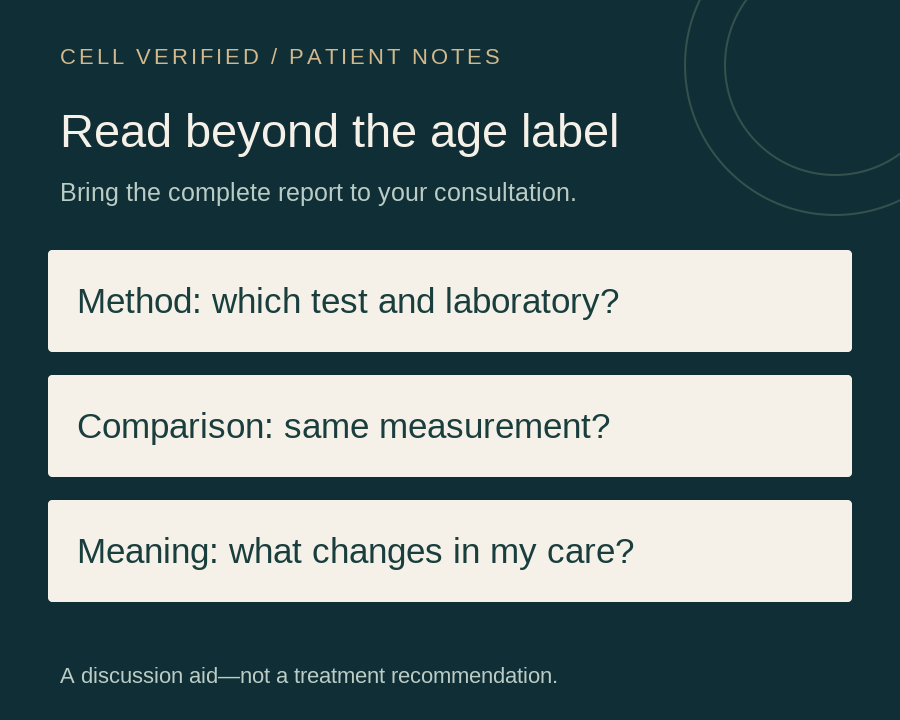
Ask for the laboratory report and the name of the method used. Different tests may use different biological measurements or models, so results labelled “biological age” are not automatically interchangeable. Record the sample date, laboratory and report version along with the headline score.
National Institute on Aging research summaries describe aging measures as tools for investigating health and aging. Their research value does not mean every commercial score has the same clinical purpose. Ask the clinician what decision the result is intended to change, rather than assuming that an attractive number explains your overall health.
Separate a prediction from an outcome
A test may be associated with future health outcomes in a studied population without proving that changing that test through a particular intervention changes those outcomes. This distinction matters when a treatment advertisement converts a numerical improvement into a claim about longer life or younger organs.
Ask the clinic to state its conclusion precisely. Does it mean that the measured score changed, that a symptom improved or that a clinical outcome was demonstrated? These are different statements. A before-and-after chart should not quietly move from the first statement to the third without supporting evidence.
Ask how uncertainty is handled
A useful discussion includes measurement variation, the timing of samples and the circumstances in which comparison is meaningful. Ask whether the same laboratory and method will be used again and whether changes in health or other treatments could affect interpretation.
- How repeatable is this test in an individual?
- What size of difference exceeds expected variation?
- Was the method studied in people similar to me?
- Is there a defined clinical action for an abnormal result?
- What would you conclude if one marker improved and another did not?
You do not need to become a laboratory scientist; you need an explanation that makes the result usable rather than merely impressive.
Compare the score with your actual priorities
Write down the problems you wanted assessed before seeing the result. These may include mobility, sleep, concentration or a diagnosed condition. Ask how the proposed program will track those priorities separately from the aging test.
If your score changes but your everyday function does not, discuss that difference openly. If you feel better while the score is unchanged, that also deserves interpretation rather than an automatic offer of more treatment. A useful review can include both your experience and appropriately chosen clinical measures without making either one stand for everything.
Avoid buying a result in advance
Be cautious about a package whose success is defined only as producing a younger test age. Ask whether the test is optional, who interprets it, what evidence connects it to the proposed preparation and whether the clinic benefits financially from repeat testing or associated services.
For a consultation in Korea, keep copies of the actual reports so your home clinician can review them. Do not use an aging score to abandon established screening or prescribed care. The best outcome of testing may be a more informed discussion, including a decision that the result does not justify an invasive procedure.
Three different meanings can hide behind “years younger”
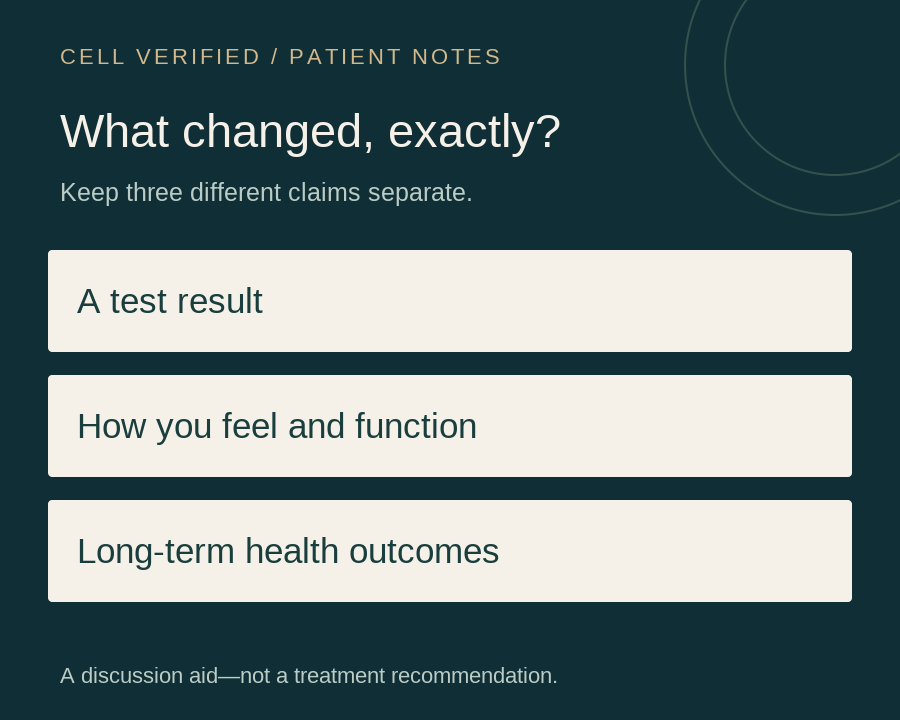
First, a laboratory may report an age estimate calculated from a set of measurements. Second, a clinician may describe a change in how you feel or function. Third, an advertisement may imply that treatment reduces future illness or extends life. Those statements require different evidence. Ask which one the clinic is making before interpreting the number.
Write the claim as a complete sentence. “My reported score was lower on a later sample” is narrower than “the treatment reversed aging.” Adding the words “because of stem cells” makes a further causal claim. A useful consultation should explain what supports each step and where uncertainty remains. An appealing graphic should not do that reasoning on your behalf.
Your chronological age still comes from your date of birth. A biological-age report does not replace the medical history, examination or risk assessment used for ordinary care. If a result changes your expectations dramatically, ask your usual clinician to review the actual report before making a new treatment commitment. You can be interested in aging science without treating a commercial number as a diagnosis.
What research can tell you—and what it cannot transfer
The National Institute on Aging’s summary of epigenetic-age research describes associations between DNA-methylation estimates and later health outcomes in older adults. It also notes the importance of other information about health and circumstances. An association can help researchers investigate risk without proving that lowering a particular score through a commercial intervention improves that risk.
A randomized CALERIE study published in Nature Aging examined calorie restriction and measures of biological aging. The analysis found a change in the DunedinPACE measure, but not significant changes in the PhenoAge and GrimAge estimates; the reported effect sizes were small. Its findings concerned a specific intervention, population and set of measurements. It was not a study of a Korean stem cell program. Ask a provider citing any such paper to identify the exact overlap with your proposed treatment and the important differences.
This distinction helps you read a reference list critically. A paper about laboratory methods may support the way a test was developed; a study of an unrelated intervention may show that a marker can change; neither alone demonstrates the benefit of your proposed infusion. Request the study that addresses the actual clinical claim, and ask what patient-important outcome it measured.
Build a comparison sheet for your own two reports
Keep the full reports side by side. Record the laboratory, test name, sample type, collection dates and any stated method version. Copy the result with its units and any uncertainty range supplied by the laboratory. If one report uses an age estimate and another a pace-of-aging measure, ask for an explanation rather than subtracting the numbers.
Next, record what happened between samples: the proposed intervention, other procedures, medicine changes and major changes in routine or health. You are documenting context for interpretation, not proving which factor caused a difference. Ask the clinician which details matter for this specific test and whether the testing conditions make the two reports meaningfully comparable.
Finally, write down the conclusion you were given and who gave it. Was it a laboratory comment, a clinician’s assessment, or a marketing message? If the summary says “rejuvenated,” ask for a more precise description of the measured change. This separates the underlying result from the story added to it and makes a second opinion much easier.
An illustrative result: a lower number with unanswered questions
Imagine a report labelled 52 before a program and 47 afterward. These are invented numbers used only to explain interpretation; they are not patient results or expected treatment effects. Before calling that five years of rejuvenation, ask whether the same method was used, what variation the laboratory expects and whether the difference has a defined clinical meaning.
Suppose the program also included several other services. A simple before-and-after comparison does not separate their contributions. Suppose only people with encouraging reports appear in a presentation. The presentation then cannot show how everyone who received the program fared. Ask about unchanged results, worse results and people who did not return for testing, as well as the favorable examples.
Now add the patient’s original goal. If the goal was better walking endurance, a report alone does not describe walking ability. If it was a skin concern, a blood-based score does not document the visible change. Decide with the clinician how the original goal will be assessed, and keep that result separate from the biological-age number.
Recommended clinics for discussing a longevity proposal
The following listed clinics publish anti-aging or cell-related programs, making them relevant places to ask what a proposed outcome measure actually means. This is a recommendation to investigate the proposal, not an endorsement of age reversal. Directory order is not a measure of clinical quality.
Cheongdam Cell Clinic, directed by Dr. Jo Chanho, describes whole-body and goal-specific programs. If its team proposes testing, ask for the name, intended use and interpretation plan before including it in your decision. Review Cheongdam’s English website.
Rapha Cell Clinic lists anti-aging and regenerative services and identifies Dr. Eungsuk Kim as its lead doctor. Ask how the consultation separates your current health concerns from a general longevity objective. Explore Rapha Cell’s English website.
Neither listing here confirms that a particular commercial aging test is offered or clinically validated. The useful request is specific: “If you recommend a biological-age test, what would each possible result change about my care?” Keep the clinical answer separate from a package description and ask who will explain the report after you return home.
Make the next decision about care, not just the next score
Before purchasing repeat testing, agree what question it is meant to answer. If no possible result would change a sensible clinical decision, ask why repeating it now is useful. If a result would lead to another procedure, ask what evidence supports that decision rule. Avoid allowing a target number to create an open-ended sequence of tests and treatments.
A balanced review can include your symptoms, daily function, conventional care and the limitations of the report. Ask whether the most useful next step is further assessment, established preventive care, observation or no additional intervention. There is no need to select an invasive procedure simply because a report labels you older than your chronological age.
If a cell-related intervention remains under consideration, discuss its own risks, alternatives and relevant authorization independently of the score. FDA patient information on unapproved regenerative therapies documents safety concerns; it does not determine the status of a particular Korean proposal. An interesting measurement should never substitute for the separate discussion of whether the actual treatment is appropriate.
Questions patients ask
Does a five-year lower score mean I will live five years longer?
No. A modelled age difference is not a direct prediction of additional lifespan for an individual, and a treatment-related change needs its own interpretation.
Should two biological-age tests give the same answer?
Not necessarily. Different methods may measure different features and use different models. Compare the actual methods and reports rather than only the age labels.
Sources and further reading
References checked 25 October 2026. Source scope and important limitations are explained in the article.
- National Institute on Aging — Research in Context: Can We Slow Aging?
- National Institute on Aging — Age Estimated by Changes to DNA Can Help Predict Health Outcomes
- FDA — Regenerative medicine patient information (US context)
- Waziry et al. — CALERIE randomized trial, Nature Aging (2023); not a cell-therapy study