Patient library / Costs, results & ongoing care
Stem Cell Treatment Quotes in Korea: What to Check Before Paying
Understand what a Korean stem cell treatment quotation includes: preparation, administration, tests, follow-up, exclusions and the questions to resolve before paying.
7 minute read · Costs, results & ongoing care
A useful quotation identifies the actual treatment and separates the medical services from travel arrangements. A single package total is not enough to compare clinics. Ask for an itemized written estimate, its validity period and the circumstances that could change it. The checklist below helps you turn a sales quotation into a clear record of what you are considering.
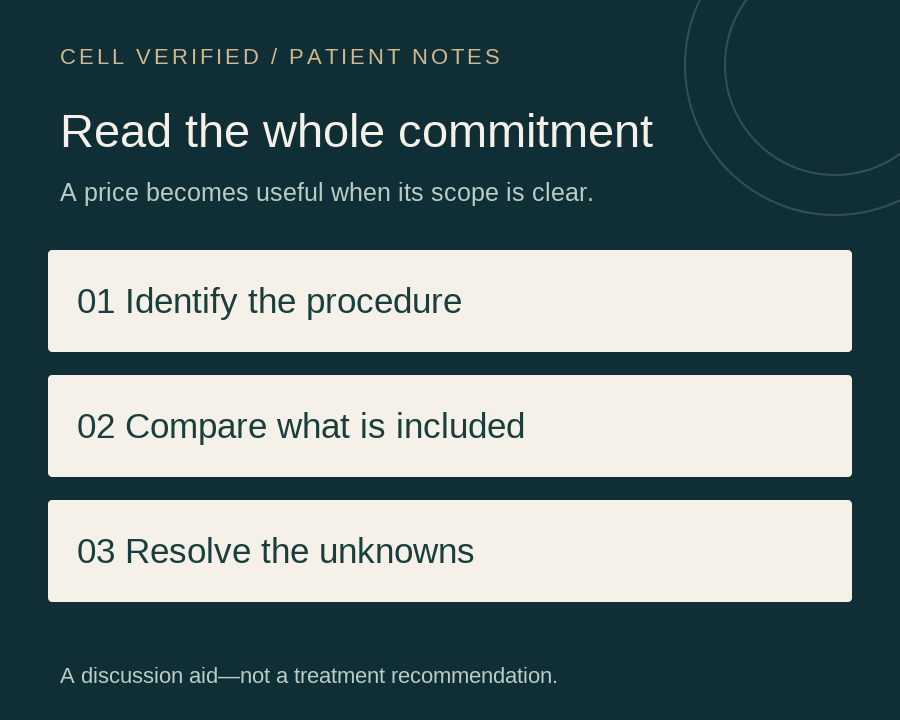
First identify what the price is for
Begin with the preparation name, source and administration route. “Stem cell package” may describe an IV program, a local procedure or surgery with an added cell-processing step. These are different purchases. Copy the clinic’s precise terms onto your comparison sheet; leave an item blank when the quotation does not identify it.
Then separate the consultation from the procedure. An initial assessment may result in a different recommendation or no treatment. Ask which charges apply if the clinician concludes that the original program is unsuitable. A quoted price is not confirmation of medical eligibility.
Request a line-by-line breakdown
Use the following headings as a request for clarification, not as a claim that every clinic charges separately for every item. The goal is to expose assumptions before they become expenses.
- Assessment: consultation, record review and any tests required before a decision.
- Preparation: tissue or blood collection, processing and any storage.
- Procedure: clinician, administration, anesthesia or sedation if proposed, and observation.
- Aftercare: medicines, dressings, rehabilitation and scheduled reviews.
- Practical support: interpretation, transport or accommodation if the package claims to include them.
Ask the clinic to mark each line “included,” “excluded” or “not applicable.” An empty line should not be interpreted as free.
Clarify the units and the course
A per-session price can look lower than a course price even when the final commitment is larger. Record the number of planned visits, whether collection happens once or repeatedly, and whether different body areas are separate items. If a dose or cell count is quoted, ask what it measures; the largest numerical figure does not establish the best treatment.
Keep the currency and payment schedule visible. Record whether the estimate is in Korean won or another currency, who determines conversion, whether taxes or payment fees are included, and when each amount is due. Avoid calculating a final home-currency commitment from an old exchange-rate screenshot.
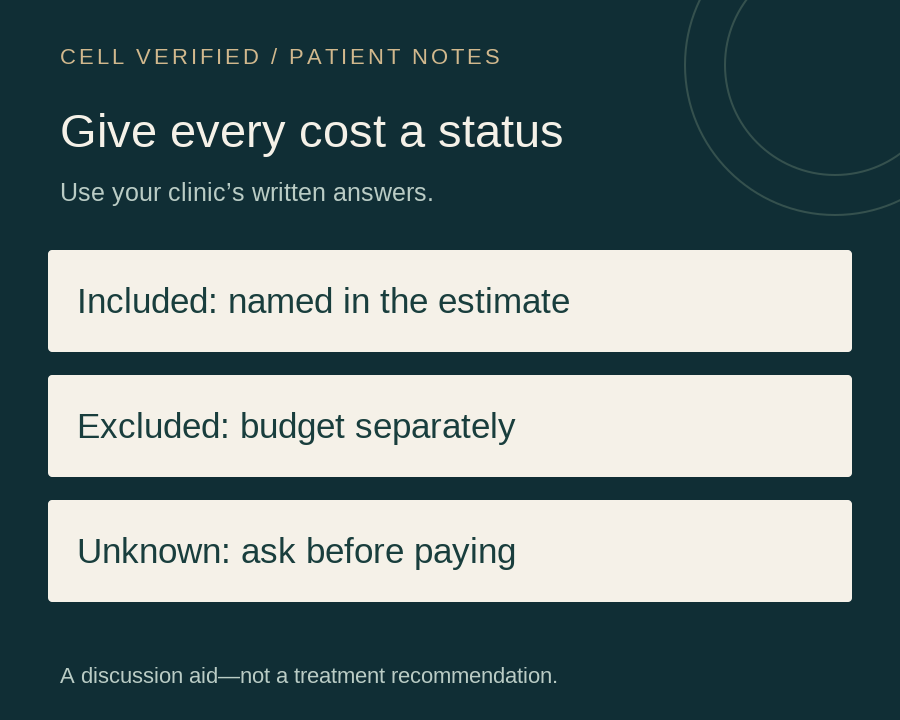
Locate the exclusions before comparing totals
Ask what happens if testing changes the proposed plan, the visit needs to be postponed, or the physician recommends additional observation. These are different situations from purchasing optional services. Request a process for approving extra charges before nonurgent additions are performed.
CDC medical-tourism guidance highlights the importance of understanding included services and follow-up charges. For your own quotation, turn that principle into a specific question: which reviews are covered, where do they occur, and which expenses remain yours if a problem needs assessment elsewhere? Do not assume a coordinator’s reassurance replaces a written term.
Keep a version you can use later
Save the dated estimate, the sender’s role and the clinic’s response to your questions. When a revised plan arrives, compare it with the previous version rather than replacing the file immediately. Make sure the invoice eventually describes the agreed services, and request a receipt identifying the provider that received the money.
A simple decision note can contain three columns: the proposed service, the agreed price and the unresolved question. Share the clinical questions with your doctor and the contractual questions with the clinic. If the information remains too vague to understand the commitment, pause payment while seeking clarification. The purpose is a transparent decision, not finding the lowest number at any cost.
Read the quote in three passes, not one
Start by checking identity: whose quotation is this, which clinic location issued it, and what clinical proposal does it describe? Next check scope: which services are included and which are still undecided? Only then compare the total. Reading in this order makes a polished package brochure less likely to distract from a missing clinical description.
This is particularly useful when your first contact is a patient coordinator. A coordinator can explain appointments and payment arrangements, but a medical question should reach the clinician responsible for the recommendation. Ask the coordinator to mark which answers are administrative and which have been confirmed by the medical team. Keep both in the same dated document.
Treat your comparison as a living record. Before assessment, it may contain an indicative package. After assessment, it should reflect the proposed care. If the procedure changes, the old price may no longer describe the new commitment. Request a revised version and enough time to read it, rather than agreeing to a verbal adjustment while preparing for the appointment.
How to compare two itemized quotes
Imagine two unnamed quotations for the same broad wellness goal. Offer A includes one consultation and one administration visit. Offer B includes assessment, collection, administration and a later clinician review. Both use the words “stem cell program.” Neither description yet tells you whether the preparation, route, or clinical purpose is comparable. This is an illustrative exercise, not a description of any listed clinic.
Create a row for each difference. If A does not mention collection, ask whether it is unnecessary for that preparation, included elsewhere, or separately charged. If B includes follow-up, ask whether that means a medical consultation or a coordinator message. Write “not confirmed” until the clinic answers; do not put zero in an unknown cost field.
Now compare the actual course you would purchase. If one proposal includes an optional second visit, keep that option separate from the agreed first visit. If your clinician recommends different approaches, you may not have a like-for-like price comparison at all. The next decision is then clinical: understanding the alternatives and their evidence before choosing a financial package.
Banking, testing and extra services need their own decisions
Cell storage can turn a one-time purchase into an ongoing commitment. If banking appears in your proposal, ask what material is stored, who holds it, the initial storage term, renewal arrangements, release charges and the process for ending the agreement. A storage line is not a promise that the material will be suitable for a future treatment. Read the separate adult cell-banking guide if this is part of your offer.
Similarly, a large testing panel can look reassuring without explaining what the clinician will do with the results. Ask which tests are needed for the proposed procedure, which investigate your symptoms, and which are optional wellness measurements. Request a separate price for optional items so you can consider them without confusing them with eligibility checks.
For additional infusions, devices or aesthetic procedures, ask for a separate purpose, evidence discussion, risk explanation and price. A package discount does not answer whether the additional service is appropriate. It is reasonable to keep your initial consultation focused on one goal and decide about other services only after that goal has been assessed.
Keep financial clarity separate from medical evidence
An itemized invoice is valuable, but it is not a safety certificate. Ask the clinician what evidence applies to the exact preparation, route and intended use, what alternatives exist, and whether the proposed use is established or investigational. The ISSCR patient questions are a useful starting point for that conversation.
The FDA’s patient information describes serious harms reported with unapproved regenerative products, including infections and other complications. That US guidance is not a determination of a Korean clinic’s legal status. For care in Korea, request the documentation relevant to the actual Korean treatment proposal; approval of a device should not be presented as approval of every treatment using it.
Ask your insurer about the exact proposed intervention and complications, rather than using only the term “travel insurance.” Australia’s Smartraveller guidance warns that ordinary travel policies may exclude medical tourism. Do not assume a policy from another country follows Australian rules: obtain your own insurer’s written answer. Keep insurance correspondence beside the quotation, and consider whether an uncovered commitment would change your decision.
Recommended clinic profiles for a quote discussion
These profiles are useful starting points because their published services match different components that may appear in a quotation. Listing here does not establish superior outcomes or recommend a procedure for you.
Cheongdam Cell Clinic publishes whole-body and goal-specific cell programs and identifies Dr. Jo Chanho as its director. Ask which program, preparation and visits your estimate actually covers. Review the clinic’s English website and request an itemized consultation estimate.
Rapha Cell Clinic lists stem cell-related and anti-aging services under Dr. Eungsuk Kim. Ask the team to distinguish cell preparation, platelet-related services, testing and any additional care on the quote. Explore Rapha Cell’s English website.
Chungdam Jeunex Clinic publishes adipose-derived programs and cell banking, and lists Dr. Sung Ki Su as chief director. It is relevant when your proposal includes collection or storage. Ask for those commitments separately. Review Jeunex’s English website. These are service and affiliation checks from provider websites, not independent evidence of efficacy or confirmation of who will perform your procedure.
Before paying: make your unanswered questions visible
Finish with a short decision note in your own words: “I am considering this procedure for this goal; these items are included; these issues still need an answer.” Read it back to the clinic. If the team describes something different, update the note before treating the quotation as agreed.
Give each unresolved issue an owner. The doctor answers suitability and treatment questions; the clinic’s billing contact answers fees and cancellation terms; the insurer answers coverage; your home clinician discusses possible follow-up. An answer from one person should not silently stand in for the others. This is a practical organization method, not a legal test of a contract.
Save the quote with its issue date and a clearly named revision number. If you decide not to proceed after assessment, request a summary of that assessment and confirm which agreed charges remain. A useful consultation can end with more information and no treatment. The money already spent on travel does not oblige you to accept a newly proposed procedure.
Questions patients ask
Does an itemized quote prove the treatment is effective?
No. Pricing transparency and clinical evidence are separate issues. A clear invoice does not establish that a proposed preparation is effective or authorized for your condition.
Can Cell Verified provide a guaranteed package price?
No. The treating clinic must assess your circumstances and confirm its current written estimate. This guide explains how to assess the scope of that estimate.
Sources and further reading
References checked 25 October 2026. Source scope and important limitations are explained in the article.