Patient library / Your consultation in Korea
After Stem Cell Treatment in Korea: Plan Care with Your Home Doctor
Prepare a clear handover between a Korean clinic and your usual specialist, covering the proposed treatment, medication decisions, records and follow-up responsibility.
7 minute read · Your consultation in Korea
Coordinate the two care teams before treatment, not only after returning home. Ask your usual clinician to review the exact proposal where appropriate, obtain permission for information sharing and agree who handles each follow-up task. A Korean clinic’s contact number does not automatically mean your home doctor has accepted responsibility for monitoring an unfamiliar intervention.
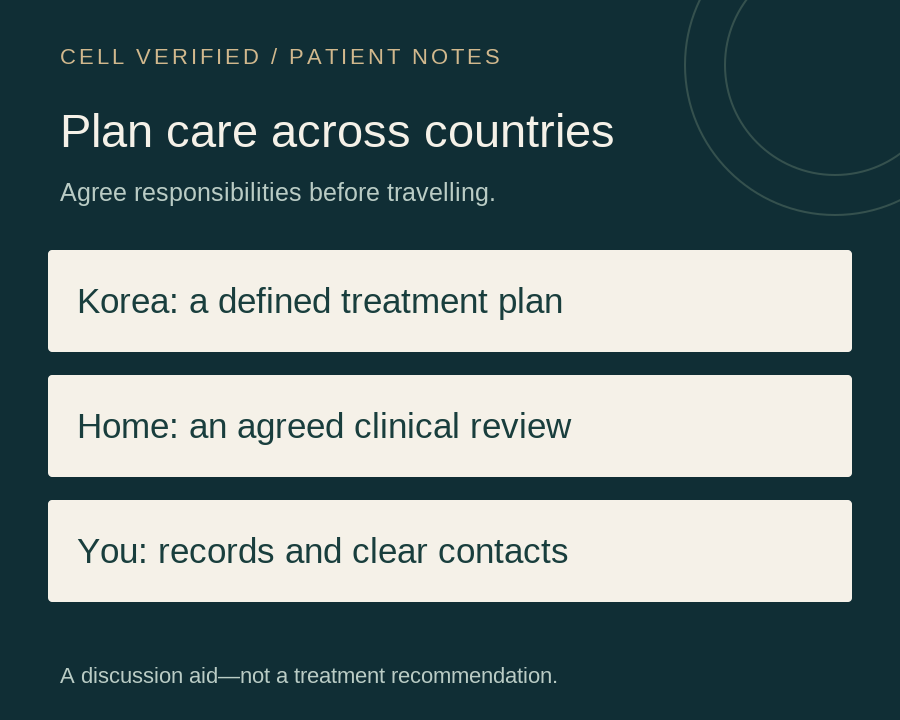
Explain the proposal before asking for support
Your usual clinician needs to know what is being considered, not only that you are travelling to Korea. Share the preparation name, cell source, route, intended purpose and any supporting procedures. Include the proposed schedule and the clinic’s evidence explanation.
Ask which parts of the proposal your clinician can assess and whether a different specialist should be involved. Be open about uncertainty. If the home clinician has concerns, request the specific questions they want the Korean team to answer. This is more useful than asking either side for a general endorsement of the other.
Agree on responsibility for ongoing medicines and tests
Before travel, ask who will advise about medicines related to your existing condition and who will assess any proposed procedural changes. Do not assume the latest message automatically replaces a longstanding prescription or monitoring plan.
For suggested tests after returning home, clarify who orders them, who receives the results and who interprets them. A list of test names in a discharge document is not the same as an accepted follow-up arrangement. Ask what the clinical team would do with the result and whether the test is available where you live.
Prepare a useful handover request
Ask the Korean clinic what documentation it will provide if treatment proceeds. CDC medical-tourism guidance highlights the importance of medical records for continuity after returning home. The record should let another clinician identify what was actually done.
| Handover item | Why it matters |
|---|---|
| Procedure and preparation | Distinguishes the actual intervention from its package name |
| Dates and administration details | Places later symptoms and reviews in context |
| Medicines and instructions | Clarifies the intended ongoing plan |
| Observations and concerns | Explains issues identified during the visit |
| Responsible contact | Allows questions about the treatment record |
Confirm how clinicians can communicate
Ask whether the Korean team can respond to a clinician-to-clinician enquiry and in which language. Obtain the appropriate professional contact rather than assuming the booking coordinator can answer technical questions. Clarify how consent to share information will be documented.
Consider time zones and expected response times. For a planned follow-up question, a secure written exchange may be practical. For an urgent medical problem, waiting for an overseas message may not be appropriate; ask both teams in advance how urgent concerns should be handled locally.
Book the first review around the clinical need
Discuss the timing and purpose of follow-up before you leave Korea. Ask what will be assessed, which records the appointment needs and who should attend. Avoid scheduling a review only because it fits a convenient date if the clinicians advise a different interval.
If the home clinician cannot provide the requested follow-up, resolve the gap rather than treating acceptance as automatic. You may need a different specialist, a revised plan or further discussion before proceeding. Coordination does not establish that the treatment is beneficial; it makes the responsibilities and information flow clearer if you decide to go ahead.
Use a shared-care agreement that names the task owner
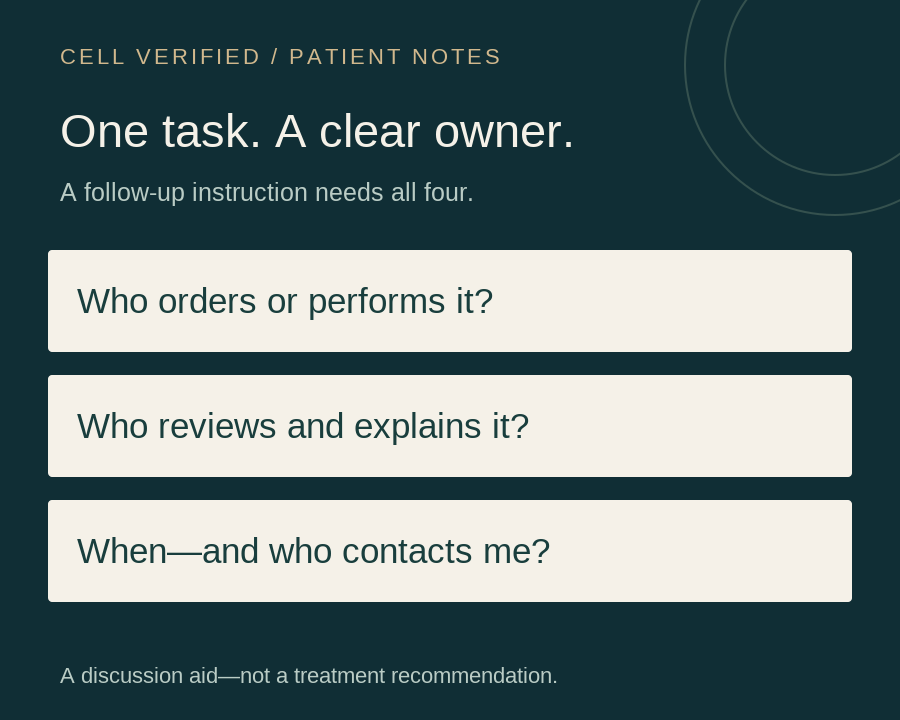
A practical handover is more than exchanging contact details. For every planned task, write down the clinician or service responsible, the expected timing, the information needed and how you will receive the answer. Use this as a discussion sheet with both teams; it is not a formal contract or a promise that either team can accept every request.
For example, a proposed blood test needs four answers: who orders it, where you can have it, who interprets it and who contacts you about the result. The same approach applies to a wound check or a medication review. If the only entry is “follow up at home,” the important decisions have not yet been made.
Mark unresolved tasks clearly instead of assigning them to your usual doctor by assumption. If that doctor cannot provide the requested service, ask what alternative arrangement is possible before committing to the trip. A gap discovered early can lead to a revised schedule, another opinion or a decision to postpone. It should not become an administrative surprise after treatment.
Send one clinical question with the documents
A large folder of records is easier to use when it has a clear purpose. Put a short cover note on top: what treatment you are considering, what the Korean team has proposed and what you want your home clinician to assess. Separate confirmed details from points still awaiting a response. Ask the receiving practice how to submit the material securely.
One useful question is whether the proposed follow-up fits the clinician’s expertise and services. Another is whether an existing condition requires a different specialist’s input. Your doctor may be able to discuss general risks without agreeing to supervise an unfamiliar intervention. Clarifying that boundary is part of an honest plan, not a failure of cooperation.
Use the medical-record preparation guide for organizing the underlying files. This article focuses on who will use those files and make decisions. Ask for acknowledgement from the clinical team rather than assuming that delivery to a general inbox means the documents have been reviewed.
Resolve conflicting advice before changing a medicine
You may receive instructions from a coordinator, a Korean treating doctor and a clinician who manages your longstanding condition. If those instructions conflict, ask the clinicians to reconcile them. Do not choose a plan based on which message arrived most recently or which advice best fits your flight schedule.
Keep a current list that distinguishes existing prescriptions from anything newly prescribed during the visit. Ask for generic names where possible, the reason for each change and the person responsible for reviewing it. This is a request for clear clinical instructions, not advice to start, stop or alter a medicine yourself. Ask how to handle any uncertainty before the next dose or procedure.
If a translated instruction is unclear, retain the original and request clarification. A family member can help organize the conversation, but should not be expected to resolve a medical contradiction. When the clinical plan changes, ask for an updated written version so both teams are working from the same information. Keep superseded versions dated rather than mixing them into the current instructions.
Separate routine messages from care that needs an examination
Ask the Korean clinic what remote follow-up can realistically cover. A scheduled discussion of a report is different from assessing a new physical finding. Obtain a procedure-specific plan explaining which concerns require local assessment and whom to contact. A messaging service should not be your only route to care when you are unwell.
The CDC’s medical-tourism guidance emphasizes continuity and access to overseas records. The NHS treatment-abroad checklist also encourages involving your own clinician and discussing aftercare before travel. For an emergency, use local emergency services rather than waiting for an overseas reply. Ask your treating team for individualized warning signs and instructions before discharge.
Make routine communications easier by including the procedure date, your question and the relevant report in one secure message. Ask for an expected response window and an alternative contact if the responsible clinician is unavailable. Do not assume that a reply from a coordinator is a medical assessment. Clarify who reviewed the question and whether further evaluation is needed.
Recommended listed teams to contact about the handover
Choose a consultation team whose published offering matches your proposed care, then ask it to explain its own handover process. These providers are highlighted for relevance and Cell Verified’s placement priorities, not because cross-border shared care has been independently audited or guaranteed.
Cheongdam Cell Clinic identifies Dr. Jo Chanho as director and publishes cell-focused programs. Ask which doctor would sign your treatment summary and answer your home clinician’s questions. Contact the clinic through its English website.
Rapha Cell Clinic identifies Dr. Eungsuk Kim as its lead doctor and advertises English-speaking support. Ask whether a clinician-to-clinician exchange can be arranged and which follow-up needs an in-person assessment. Review Rapha Cell’s English website.
Neither a doctor’s public profile nor an English-language website confirms availability for your dates or acceptance of a particular shared-care arrangement. Request an explicit answer before treating it as booked. Your usual clinician’s agreement is a separate step. The goal is a workable relationship between the people actually responsible for your care, not simply a list of impressive professional names.
Rehearse the handover before departure
At the final review, ask yourself whether another clinician could understand the episode without reading your entire booking conversation. Check that the summary describes what actually happened, including any difference from the original proposal. Confirm which results remain pending, who will send them and what you should do if they do not arrive as expected.
Test the practical details while help is still available. Can you open the files? Are the names and dates correct? Does your home practice accept that file format? Is the next review genuinely booked or merely suggested? Keep your own copy of the agreed plan and a separate record of questions still outstanding.
Cost also needs an owner. A consultation included in the Korean package does not automatically pay for an examination, imaging or specialist visit at home. Ask each provider about its own charges and ask your insurer about coverage. Smartraveller’s medical-tourism advice highlights insurance limitations; your own policy and country arrangements require a direct answer.
After returning, bring the actual treatment record to the agreed appointment and explain any new concerns. If you decide not to proceed with the overseas treatment, close the loop with both teams so appointments and instructions can be updated. Shared planning should support the decision you make, including postponement or no intervention; it does not itself establish that a proposed cell therapy is beneficial.
Questions patients ask
Will my usual doctor automatically provide follow-up?
No. Ask in advance what care they can provide and which information or specialist input they need. A proposed overseas treatment does not itself create an agreed follow-up arrangement.
Should I send the whole clinic chat history to my doctor?
A dated clinical proposal and complete treatment record are usually easier to assess than scattered messages. Ask which supporting material is relevant and use the agreed secure channel.
Sources and further reading
References checked 25 October 2026. Source scope and important limitations are explained in the article.