Patient library / Costs, results & ongoing care
The Medical Records to Take Home After Cell Treatment in Korea
Build a discharge folder that helps your next clinician understand exactly what happened and what needs follow-up.
14 minute read
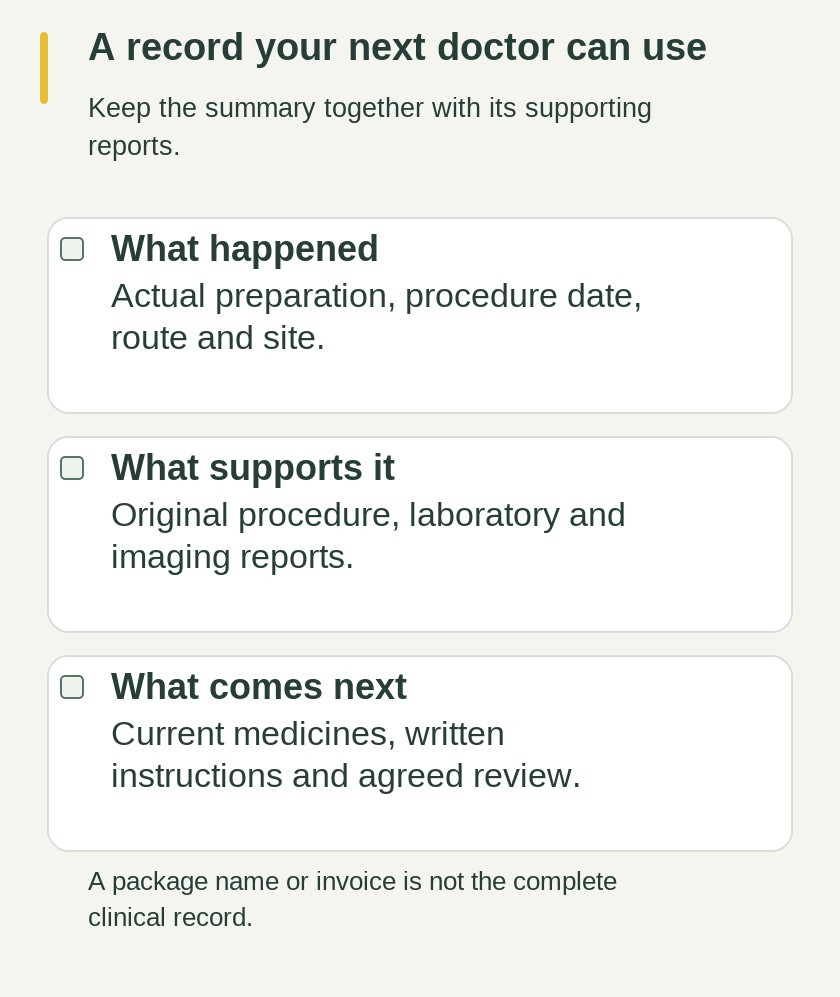
Before leaving Korea after a cell-related procedure, ask for a medical summary that identifies what you actually received, a reconciled medicine list, written aftercare instructions and a plan for any results still pending. Keep the original reports as well as any translation. A receipt, treatment package name or photograph of an infusion bag cannot tell your next clinician everything they need to know.
This guide helps you check the contents of that folder. It does not establish that a treatment is effective or suitable. If you have not yet travelled, use the records to prepare before consultation guide; if the question is who will provide follow-up, use the shared-care planning guide.
Request the discharge pack before the final appointment
Ask the clinic when the documents will be ready, who prepares them and whether there is a fee for copies or translation. Give the team your intended departure date, but do not let a flight booking replace the clinician's assessment of when you can travel. Some reports may be ready immediately; others may need a later addendum. Request a list of what you will receive now and what will follow.
Tell the team which clinician will read the record at home and which language that clinician accepts. English can be useful across borders, but it is not automatically the best or sufficient language for every receiving practice. Ask the practice directly. CDC medical-tourism guidance advises obtaining overseas records in English and sharing them with subsequent healthcare professionals. Retain Korean originals so the source can be checked if a translation is unclear.
Do not wait until an airport transfer arrives to open the files. Put time for this check into the final clinic visit. If a document is missing, ask whether a clinician can provide an interim summary and identify the person responsible for the completed version. Keep that outstanding item on a short list rather than burying it in a long message conversation.
Make the actual intervention identifiable
Start with your name, date of birth or other agreed patient identifier, the clinic, treating clinician and procedure date. Check that the document describes the actual episode rather than copying the original quotation. If the plan changed after assessment, the final record should explain what was performed, what was omitted and the clinical reason for the change where relevant.
For a cell-related preparation, ask the treating team to identify the preparation or product, its source and the route and site of administration. Ask whether cells came from you or from a donor and whether collection, processing and administration occurred on different dates. If a preparation was injected into a particular joint or area, the side and site should be unambiguous. A label such as “regenerative program” is a starting point for a question, not an adequate description by itself.
Ask for batch, lot or other traceability information where it applies, together with any laboratory report that the clinician considers relevant to your care. These are requests for a useful clinical record, not a universal checklist of legally required documents. Different interventions generate different records. A count or viability result alone does not prove that a treatment will work; if you receive such a report, use our cell count and viability guide to prepare questions.
Keep the consent copy separately but nearby. Consent records the information discussed before a decision; the treatment summary records what happened afterward. One cannot substitute for the other. The ISSCR informed-consent standard addresses disclosure before stem-cell-based interventions outside formal trials. Neither a signed form nor a tidy discharge folder establishes clinical benefit or regulatory authorization.
Keep the reports behind the summary
A short summary is useful when it points to the supporting material. Ask which procedure notes, collection records, laboratory results, imaging reports and other documents the receiving clinician needs. If another treatment occurred during the same visit, include its name and report rather than treating it as a minor extra. This can matter when someone later tries to understand the sequence of events.
Check that reports include the patient identifier, date, complete result and relevant units or reference ranges. Do not crop screenshots so tightly that those details disappear. A coordinator's translated message may help explain a report, but retain the complete original. If a test was repeated, keep both versions labelled by date instead of replacing the earlier file.
For scans, ask your receiving practice which image format it can use and how it wants the images transferred. A photograph of a screen may not allow the same assessment as the original study. Test any download link while you can still ask for help. Record when links expire and whether a separate viewer or access code is needed, without putting passwords into a public document.
Reconcile medicines before you pack
Put the pre-trip medicine list beside the discharge list and ask a clinician or pharmacist to explain every difference. Mark which medicines are continuing, newly prescribed, changed or stopped by the responsible clinician. Include generic ingredient names as well as brand names, the strength, instructions and intended review point. Do not interpret a missing medicine on a new list as an instruction to stop it.
If two teams give conflicting instructions, ask them to resolve the conflict before you act on it. A translated brand name, abbreviation or message timestamp is not a safe way to choose between prescriptions. Keep the revised written plan and mark which older version it replaces. Record whom to ask if a medicine cannot be obtained at home, rather than assuming another product is interchangeable.
Medical instructions and border permission are separate questions. For medicine transport, use the prescription medicines travel guide and the relevant authorities for every destination. A discharge prescription does not automatically satisfy import rules, and travel paperwork does not tell you whether a medicine is clinically appropriate.
Give every pending result a named next step
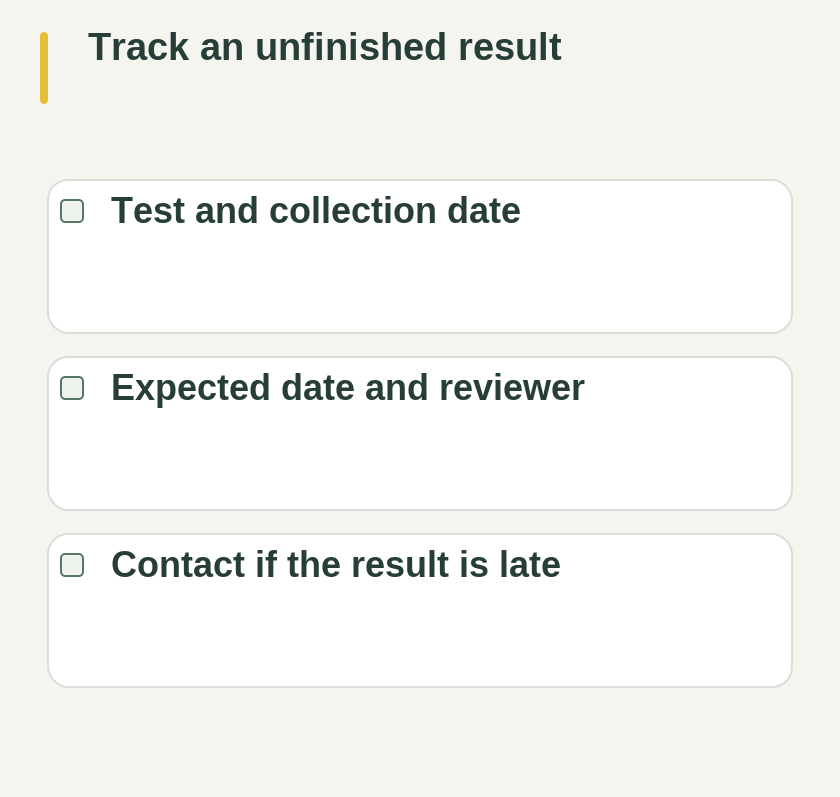
A report marked pending is not a normal result. Ask which tests are unfinished, approximately when the report is expected and which clinician will review it. Write down how you will receive the result and what to do if it does not arrive. Where timing is uncertain, agree a date to check back; that is an administrative reminder, not a deadline for medical reassurance.
Use four fields for each outstanding item: the test or document, the responsible clinical team, the expected contact date and the action if there is no reply. Distinguish receipt from interpretation. A portal notification may mean a file is available, not that a clinician has assessed it or discussed its implications with you.
If the result might affect travel or treatment decisions, ask the treating clinician whether the decision can safely be made before it is available. Do not infer clearance from silence. For routine results sent after departure, confirm that the receiving doctor can access the report and knows why the test was ordered. A file sent only to an old email address is not a completed handover.
When a report is sent later, add it to the same dated folder and tell the receiving practice what has changed. Avoid resending the entire folder without a note, because the new result may be overlooked among familiar documents. Ask whether the clinician needs to see you again or whether the next step can be discussed through the agreed channel.
Separate home instructions from clinical appointments
Request written, procedure-specific advice about daily activities, care of any collection or treatment site, medicines and the next review. Ask which changes require a call, which require assessment locally and what to do outside clinic hours. Read the instructions back in your own words so the team can correct a misunderstanding before you leave.
A statement such as “follow up at home” is incomplete until you know where, when and with whom. Keep the appointment confirmation beside the summary and check whether the receiving service has accepted the referral. The NHS treatment-abroad checklist emphasizes planning aftercare and discussing it with your own clinician. Its funding rules are UK-specific; the practical need to clarify arrangements is relevant more broadly.
If you become unwell, do not postpone local assessment while trying to perfect the folder or obtain an overseas reply. Tell the assessing team about the trip and procedure even if you are unsure whether they are connected to the new problem. Bring the information already available and ask the clinic to forward the rest securely. The record supports care; it should never become a reason to delay it.
Use a simple folder that another person can navigate
Keep a one-page overview at the front: procedure date, actual intervention, current medicines, allergies, follow-up appointment and clinical contact. Behind it, separate procedure records, test reports, imaging and instructions. Put invoices and insurance correspondence in a different section. They may be important for payment questions but should not obscure the clinical information.
Use filenames that identify document type and date without exposing unnecessary personal details. Keep one secure backup and an accessible copy for travel. Ask the receiving practice how to transfer records rather than sending them through an unfamiliar link or a public review. Share only with people who need the information, and ask a companion's permission before assigning them responsibility for storing or sending it.
Before sending, verify the recipient and check that every attachment belongs to you. If you find a name, date or side error, request a corrected clinical document. Do not edit the report yourself. Retain the original and the corrected version with a clear explanation of which should be used. This makes later questions easier to resolve without changing the medical record's history.
A listed clinic to ask about a cell-treatment record
Cheongdam Cell Clinic is a relevant consultation option because its official international website describes cell-focused programs in Seoul. If you are considering one of those programs, ask how the clinical record distinguishes the program name from the actual preparation and administration details. That question is particularly useful when the same visit involves more than one procedure.
Review the clinic's English-language website and ask what discharge summary, supporting reports and clinician contact would be available for your proposed care. Request the document language, delivery method, any charge and expected timing in writing. The recommendation is based on the published service's relevance to this article, not a claim that the clinic's record-transfer process has been independently audited or that any cell intervention is suitable for you.
Questions to resolve before leaving
Is an invoice enough?
No. Billing information may identify a purchased package, but ask for a clinician's account of the actual intervention, findings and follow-up instructions. Keep both documents because they serve different purposes. If their descriptions differ, ask the clinic to explain rather than assuming either document is a complete treatment record.
Can I use an automatic translation?
It can help you recognize the subject of a document, but unfamiliar clinical terms, units and medicine instructions need reliable clarification. Ask the receiving clinician what translation is required, retain the original and identify who prepared the translation. Do not use an uncertain translation to change treatment or decide that a concerning result is harmless.
What if I decide against the procedure?
Request the consultation findings and any test reports already produced. Ask the clinician to distinguish a recommendation from treatment actually delivered. Your next doctor may still need the assessment, and a clear record prevents an abandoned proposal from being mistaken for a procedure you received.
Can I still open my results after my Korean SIM expires?
At the last visit, try opening a report on the device you will take home. If the sign-in code goes to a temporary Korean number, ask how to change the number or arrange another secure delivery method while the clinic can confirm your identity. Download one complete report and check its patient name, date and page count. For a result that is still pending, agree on a contact who can restore access and a clinician who will explain the result. These may be different people.
My discharge summary and treatment note disagree. Which one should my doctor use?
Imagine a summary describes a left knee procedure and the separate report says right. Neither you nor a translator should silently “fix” the version that looks wrong. Keep both originals and mark the exact lines on a separate note. The important question is what actually happened. A receipt may tell you which service was billed without resolving which side was treated.
Contact the issuing clinic through a verified channel. Identify the document dates and the conflicting details. Ask who can check them against the contemporaneous procedure record, how the answer will be documented, and how your home clinician can confirm its source. If the clinic issues an amendment, ask for the date and author, the document it refers to, and whether other recipients will receive the correction. Keep the amendment alongside the original.
Tell your home clinician about the disagreement before another decision depends on it. A conflict about a medicine or an active symptom may need clinical attention before paperwork is sorted out. Seek timely medical advice locally if needed. A difference of clinical opinion is another question: ask both clinicians to explain the reasoning rather than requesting that an opinion simply be erased.
My home doctor asked for the scan. Is a PDF of the report enough?
Ask the receiving office which examination they need, whether they need the radiologist’s written report, the original image series, or both, and how they can receive each. The report records the reading. The image series allows a clinician with appropriate software to review the examination or compare it with earlier images. A photograph of a screen or a single image in a PDF may leave out views that matter. An imaging request does not by itself mean another scan is necessary.
Before leaving Korea, match the patient details, examination date and body area on the report with those on the image transfer. Ask the receiving office whether its system accepts the secure transfer method, disc or standard image files offered. Keep any access instructions separate from public messages. If an upload fails, ask both offices which part is missing before paying to repeat an examination. RadiologyInfo · ACR / RSNA.
The same blood test has different units on two reports. Can I compare the numbers?
Keep each number beside its original unit, date and laboratory reference interval. A high flag on one report and no flag on the other need an explanation from the clinician who knows why the test was ordered. Laboratories can use different methods, units and ranges. A change in the printed figure alone cannot establish that a procedure helped or harmed you.
Send your home clinician both complete reports rather than a typed pair of values. Ask whether they measure the same substance in a comparable way and whether repeating a test at the same laboratory would answer a clinical question. If one report is translated, send the original too. Have the laboratory clarify a missing unit before entering the result into your personal tracking chart. MedlinePlus.
My discharge letter says “drug allergy” without naming the drug. What should I request?
Ask the treating clinician for an amendment describing the suspected medicine, what happened and when it happened in relation to the dose. If several products were given, ask which names are confirmed and which are still uncertain. Request the original account as well as a translation and ask what must be avoided pending review. Share the record with your home clinician and pharmacist. A vague warning can hide an important reaction; it can also unnecessarily limit future care. Do not test the suspected medicine yourself. NICE CG183.
My name is spelled differently on two reports. How do I check they are mine?
Keep both reports as issued. Contact the records desk through the clinic’s secure channel. Identify the affected report, the appointment date and the exact difference, including the order of family and given names. Ask what proof the desk needs and how to send it safely. A transliteration difference can be harmless, but it cannot confirm the report belongs to you.
Ask the clinic to match the report to its patient identifier and the correct encounter, then issue a corrected copy or a written explanation. If a report may concern someone else, avoid forwarding it. Tell your home clinician which result is still unverified and use the corrected, dated record for the handover. NHS England.
A test is still pending when I fly home. Who will tell me the final result?
Before you leave, ask for the test name, collection date, its expected reporting window and the clinician or service that will review it. Agree how the clinic will reach you across time zones and whom you can call if that window passes. Check whether the result will also be sent to your home clinician and whether you need to authorize that transfer. Keep the preliminary note marked as preliminary. Silence, or a portal that still shows “processing,” does not give you a clinical interpretation. Ask who will explain the result and any change to your follow-up plan. AHRQ PSNet.
Sources and further reading
Cell Verified editorial team · AI-assisted research and writing. Editorial policy